You have 0 items in your cart
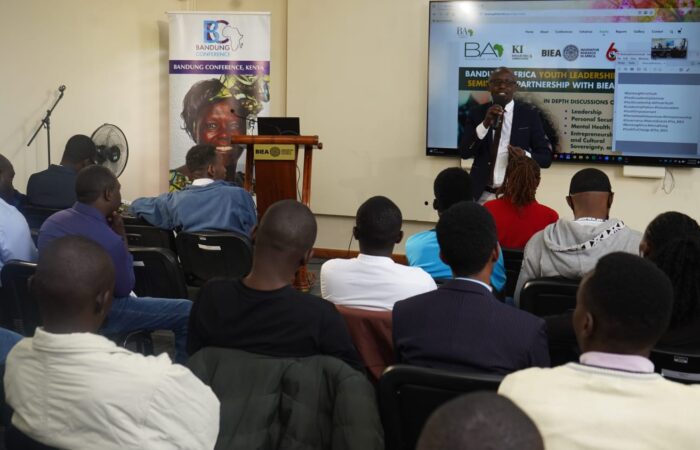
NAIROBI – Six months after the death of Kenya’s most famous opposition leader, Raila Odinga, a different kind of political gathering took place in a modest lecture theatre at the British Institute in Eastern Africa. There were no campaign speeches, no rival factions. Instead, a retired British judge, a former university vice‑chancellor, a county assembly member, and a handful of young climate activists sat down to debate three words: drought, development and dignity.
The hybrid webinar on 29 May, organised by the pan‑Africanist charity Bandung Africa and hosted at the BIEA’s Nairobi hub, was titled “Jobs, Development and Dignity: Ubuntu Solutions for Climate and Agricultural Transformation”. Yet the conversation quickly distilled itself into a blunt diagnosis of why Kenya, a country with abundant rainfall, fertile soil and a youthful population, remains chronically vulnerable to drought, hunger and political disillusionment. Across the evening, one truth became unmistakably clear: the crisis is not merely environmental. It is a crisis of leadership.
Kenya is still absorbing the shock of Odinga’s death on 15 October 2025. President William Ruto called him a “beacon of courage”. Yet the political vacuum left by the man known as “Baba” (Father) has only deepened the country’s pre‑election fragility. The space Odinga once occupied, holding power accountable, is now a battlefield, with new opposition figures stepping into the breach. With elections scheduled for next year, the cost of living is soaring, development spending has been slashed to service mounting debt, and trade unions warn that early political rallies could spiral into violence. As one audience member put it bluntly: “In Africa, leaders tell us what they are going to do, but they don’t listen to our grievances. We need to become activists that put our leaders to task.”
Against this backdrop, a conversation about indigenous philosophy and farming might seem peripheral. But the panel argued it is central to Kenya’s survival. The ghosts of two great thinkers haunted the room: Frantz Fanon and Steve Biko. From Fanon’s The Wretched of the Earth came the enduring truth: “For a colonised people, the most essential value, because the most concrete, is first and foremost the land: the land which will bring them bread and, above all, dignity.” From Biko, writing in the bleakest years of apartheid, came the charge that African leadership must be accountable to its own: “The most potent weapon in the hands of the oppressor is the mind of the
oppressed.” To break that mental bondage, Biko argued, requires a fierce, collective reclaiming of self‑worth, precisely the work of Ubuntu.
This, the panel insisted, remains the unfinished business of the continent.
‘The university has put itself as a library tower’
The opening salvo came from Canon Prof. Wangari Mwai, a former vice‑chancellor and Anglican priest. “Higher education has been aloof,” she said. “The university has put itself as a library tower, far from the people. When we collect data, we make respondents detached from reality. We go to conferences in Europe, but we never come back to share with the people who gave us the information.”
She illustrated the point with a story about a scientist who published acclaimed research on African indigenous vegetables, managu, a highly nutritious leafy green, but could not communicate her findings to the farmers who grew them. “The community thought that eating managu meant you were suffering,” Canon Wangari said. “They associated it with colonial‑era hunger. So we used performing arts, songs and stories, to re‑educate them.”
The panel agreed that universities must move beyond internships and introduce mandatory service‑based learning. Asher Ngina Mwiriigi, founder of the ANM Foundation and an incoming politician, pointed to Strathmore University’s model: every student, regardless of faculty, must complete 225 hours of graded community service. “That is how I started my foundation,” she said. “I went to an orphanage not because I wanted to, but because the curriculum demanded I understand.”
The unmaking of the African farmer
Hon. Apopo Lentana Adoto, a Member of the County Assembly from Homa Bay, turned to agriculture. “In our schools, farming is treated as a punishment,” he said. “Students look at it as something you do when you fail. We need to make agriculture a professional course, not just for food security, but as commercial agriculture.”
Kenya was once the world’s second‑largest avocado producer and a coffee giant. Today, farmers receive bags of “fertiliser” that turn out to be coloured sand. “What do you expect?” one audience member asked bitterly.
Maria Kimata, a consultant in peace building, child protection and mediation in partnership with Bandung Africa, traced the disdain for farming to colonial trauma. “Agriculture was weaponised during colonial times,” she said. “It was associated with slavery and punishment. Our parents told us, ‘If you don’t study, you will go back to the village to till the land.’ That trauma has been passed down. Even now, if I introduce myself as a farmer in a corporate room, people wait for the punchline, until I show them a cheque.”
Yet there are signs of a generational shift. Young people on TikTok and YouTube are documenting their farming lives and selling produce directly. A young woman who left the United Kingdom to package her grandparents’ tea for the European market was held up as the new face of African agriculture. “She is hardly 30,” Canon Wangari said. “All is not lost.”
The water paradox
Judge Peter Herbert OBE, the retired British human rights barrister, former lead counsel at the International Criminal Tribunal for Rwanda, and co‑chair of Bandung Africa, has lived in Kenya long enough to be both insider and outsider. He made the most arresting intervention of the evening.
“Twenty miles outside Nanyuki, there is very little sustainable agriculture,” he said. “Cows, sheep, goats are vulnerable to drought. Yet there are no small dams or lined ponds. I grew up near a farm in north‑east England, water harvesting is normal there. Every village in France has small dams. Why not here?”
Nana Abban, joining from Tanzania, added: “I am originally from Jamaica. Almost every house has roof troughs to collect rainwater. When I came to Ethiopia and Kenya, I saw that even after a rainy season, no water is stored.”
Judge Herbert then recounted a meeting with the Moroccan ambassador to Kenya, who told a local governor: “You Kenyans have more water than you know what to do with. Morocco has water falling on only 23 per cent of its land, yet 98 per cent of Moroccans have drinking water and constant electricity because of political will and infrastructure. If you have irrigation systems, there should be no drought anywhere in this country.”
The room fell silent. The panel’s conclusion was stark: Kenya’s problem is not a scarcity of water but a scarcity of collective action and political will. The sense of abandonment is palpable in towns like Nanyuki, where residents have taken to the streets over broken promises and where well‑documented allegations against British soldiers have fuelled a deeper mistrust of authority. Their frustration echoes the panel’s central grievance: ordinary Kenyans feel unheard.
The Ubuntu philosophy, “I am because we are”, was offered as the remedy: communities building small dams together, churches and mosques teaching water harvesting, and schools normalising rainwater collection.
The land question and the grip of multinational capital
As the evening wore on, the conversation turned to the structural issue underpinning all others: land. It was here that the most sobering facts emerged, forcing the panel to move from philosophical discussion to a critique of contemporary neo‑colonial extraction.
Kenya is haemorrhaging its agricultural sovereignty. A 2023 National Land Commission (NLC) report revealed that more than 1.2 million acres, an area larger than the counties of Kiambu and Murang’a combined, are held under foreign‑linked leases, many structured to obscure ultimate ownership. The consequences for food production are devastating.
When multinational companies lease vast tracts to grow alfalfa for Saudi dairy herds or jatropha for European biofuel, they are effectively exporting Kenya’s water, topsoil and labour, while the country is forced to import expensive food. Every acre planted for foreign consumption is an acre not producing maize, beans or vegetables for Kenyan households, a dynamic that pushes up the price of the staple unga (maize flour) and basic sukuma wiki (collard greens).
The economic mathematics are brutal. A 2020 KIPPRA study found that for every 100 Kenyan shillings of output from foreign‑leased land, only 32 shillings remained in Kenya. By contrast, Kenyan‑owned farms retained 71 shillings for the same output. Asher Ngina Mwiriigi dismissed excuses about capital shortage. “I cannot compete with Del Monte alone,” she said. “But if we farmers come together in cooperatives, we beat the big hotels. Numbers are Ubuntu.”
The issue transcends economics. In the Tana River Delta, large‑scale land acquisitions by foreign firms are reducing available pastures and farmland for local communities, sparking protests over environmental and social impacts. In the potato sector, European companies are aggressively capturing the seed system, pushing smallholder farmers out of agriculture and criminalising age‑old farmer‑managed seed practices. This is the contemporary reality of Fanon’s warning: the land, which should provide bread and dignity, is being re‑appropriated for external profit. And it is happening under the watch of leaders who, too often, are silent.
Youth, accountability and the ghost of Wangari Maathai
Briton Sheriff, a geospatial researcher and founder of Sprouting Green Initiative, rejected the narrative that young people are mere “passive recipients of climate aid”. He cited the World Scouting’s “Food for Life” programme, a Scout‑led agricultural initiative that began in South Africa in 2006 and has spread to Kenya, Uganda and Burundi. “Young people are already feeding their households,” he said. “The only problem is finance that is not inclusive.”
The discussion then turned to leadership accountability, a live wire in a country still mourning Odinga and bracing for elections. An audience member, Hilda, said: “Politicians say what we want to hear to buy votes. They promise fertilisers, but deliver coloured sand. We need to keep them in check, not just awareness, but a strict mechanism of accountability.”
Canon Wangari invoked her namesake, Wangari Maathai, the Nobel laureate who founded the Green Belt Movement and became, in 1971, the first East African woman to earn a doctorate. “She never became president because people thought she was doing a funny thing, planting trees,” Canon Wangari said softly. “Now we see the impact. We need leaders who are service‑based. What has this person done on the ground before asking for our vote?”
Steve Biko’s voice echoed in the silence: black consciousness, he wrote, is “the realisation by the black man of the need to rally together with his brothers around the cause of their oppression”. The panel had no illusions about the scale of the task. But they insisted that Ubuntu, the recognition that one’s humanity is bound to another’s, offers a path out of the paralysis.
Epilogue: what comes next
As the webinar closed, Judge Herbert rose again to extend two invitations. The first was to the 8th Bandung Africa Conference in Addis Ababa, Ethiopia, later this year, a week of debate and connection, with a 10‑hour bus journey on the “Abyssinia” for the adventurous. “Even I am taking the bus,” he joked. The second was to a local partnership in Nairobi’s Ololua Forest, where, according to Judge Herbert, a small Rastafarian community has been quietly building a sustainable settlement on unused land. “Can we do some water harvesting? Can we grow vegetables? Can we negotiate with the Kenya Forest Service and see what we can produce for marketing, train farmers, and so on?”
The participants filed out into the Nairobi night. The city hummed with its usual contradictions, luxury sport utility vehicles idling beside street vendors, the scent of rain on the horizon. But in that modest lecture theatre, a different future had been sketched: one where farmers are called entrepreneurs, where universities serve communities, where water is harvested as a sacred trust, and where Ubuntu is not a slogan but a working philosophy.
Whether Kenya’s politicians, or its voters, will listen remains the open question. But the conversation, at least, has begun.
This dispatch is based on the webinar “Jobs, Development and Dignity: Ubuntu Solutions for Climate and Agricultural Transformation”, organised by Bandung Africa and hosted by the British Institute in Eastern Africa (BIEA), Nairobi, on 29 May 2026. Bandung Africa is a pan‑Africanist charity co‑led by Judge Peter Herbert OBE. Raila Odinga’s death was reported by the BBC on 15 October 2025. The “Food for Life” programme is documented by World Scouting. Strathmore University’s service‑based learning requirement is 225 hours. Wangari Maathai received her PhD in 1971. The land data is drawn from a 2023 National Land Commission (NLC) report and a 2020 KIPPRA study. The Moroccan ambassador’s quotation and the Ololua Forest community project are presented as spoken by attendees at the event.
By Joseph Oesi
Joseph Oesi is a British-South African journalist and filmmaker. His Dispatches from Africa series reports on the intersection of politics, climate and grassroots innovation across the continent. He is currently based in Nairobi.